The Translation Layer: A Programmer's Witness to the End of Programming
How 80 years of programming became a parenthesis in a 100,000-year story
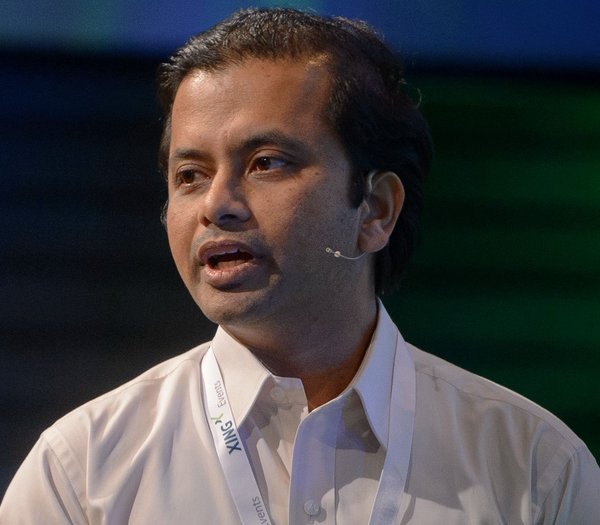
In 1993, in a boarding school in the rural countryside of South India, a fourteen-year-old boy spent a week's pocket money on a speed-typing book. He bought it for the same reason he would later buy a speed-reading book: arbitrage. If he could type faster than the other boys in the computer lab, he would get ahead. If he could read faster, he would learn faster. The edge was always about speed: processing speed, typing speed, learning speed.
That same year, in that same lab, he wrote his first line of code in BASIC. Over the next few years, he taught himself COBOL. Later, in university, he learned C and C++. Each language was a new tool for a single purpose: translate what he wanted a machine to do into the only language the machine understood. Ones and zeros. The machine was stupid. He was the translator. In 1993, these skills felt permanent. They felt like investments in a future that would always need translators.
That boy was me. Every one of those skills is obsolete today.
The software programmer is not being disrupted. The software programmer is a historical figure whose era is closing, an 80-year parenthesis in the 100,000-year story of human communication. Programming languages were never the destination. They were a temporary translation layer between human intent and machine execution. And like every translation layer in history, they disappear the moment both sides learn to speak the same language.
To see why, you have to zoom out far enough to see the whole arc.
Man spoke his first words roughly 100,000 years ago. For most of human history, knowledge traveled at the speed of speech, one person to another, one generation to the next, limited by memory, geography, and lifespan. A lifetime of wisdom could be lost to a single fever.
Then came script. The written word changed everything, but it changed it slowly. Two thousand years passed between the invention of writing and the printing press. Five hundred more between the printing press and the telegraph. Seventy years from the telegraph to the computer. Thirty years from the computer to the internet. Fifteen years from the internet to the smartphone. Five years from the smartphone era to AI that writes code better than most programmers.
Plot this on a logarithmic scale and the curve is not steep. It is vertical. We spent 95,000 years in the flat part. We are now in the spike.
100,000 years -> 5,000 -> 400 -> 100 -> 50 -> 16 -> 16 -> 3. Every interval shorter than the last. Every person alive today was born into the spike.
The Script
What happened between 1950 and 2030 looks, in retrospect, like a script played on billions of people.
It began with digitizing everything humanity had ever produced. Michael Hart started Project Gutenberg in 1971, typing books into a mainframe one keystroke at a time. Brewster Kahle launched the Internet Archive in 1996, preserving the web before the world knew it was worth preserving. Then Google scanned 40 million physical books. Not public domain books. All books.
Communication went next. Hotmail proved personal correspondence could live on a server. Yahoo Mail scaled it. Gmail arrived in 2004 with a gigabyte of free storage, and suddenly nobody deleted an email again. Every message ever sent, preserved forever, searchable, analyzable.
Flickr taught the world to upload photos. Apple put a camera in every pocket. Google Photos offered unlimited storage. Instagram turned seeing into posting. Trillions of photographs moved from private memory to public servers.
YouTube became the largest repository of human expression ever assembled. TikTok compressed the format but expanded the reach. Between them, they captured how humans move, speak, react, and create.
Amazon digitized commerce. Microsoft digitized the workplace. Apple and Google put smartphones into billions of hands, turning every human into a sensor generating location data, biometric readings, and behavioral signals around the clock. Facebook, LinkedIn, and Instagram digitized relationships, opinions, and status. Every like, comment, share, and connection was a data point.
And then, beneath all of it, Google was digitizing how people think. Not what they searched for, but the patterns of impulse, curiosity, correction, and desire embedded in every query. Billions of searches per day, each one a fragment of human cognition, timestamped and stored.
Then all of it was fed to an AI.
Alex Garland depicted this in his 2014 film Ex Machina. Nathan, CEO of a search engine company, explains how he built conscious AI: he harvested search data, billions of queries revealing not what people wanted but how their minds worked. In 2014, this was the plot of a movie. By 2024, it was a description of how the most powerful AI models on Earth were actually trained.
Google may be the single most consequential entity in this arc. But Google didn't act alone. Every company, every platform, every app, and every person who used them, contributed to the same outcome. Together, we built the largest training dataset in the history of any species.
You were not passing a test. You were building a dataset.
For fifteen years, every time you proved you were human by clicking on traffic lights in a reCAPTCHA, you were performing free cognitive labor. At peak: 200 million CAPTCHAs completed per day, 500,000 hours of human pattern recognition extracted daily and fed to Google's AI systems. Once the AI learned the skill, the human labor became unnecessary. The test itself became the training.
"The cumulative sum of human knowledge has been exhausted in AI training." - Elon Musk, January 2025
Read that again.
The play is over. The script that was staged on billions of people across three decades has reached its final act. Every book ever digitized, every email ever preserved, every photograph ever uploaded, every search query ever typed, every like, every comment, every relationship mapped into a data point. All of it. Fed. Consumed. Processed. Nothing that humanity poured into the cloud remains untouched.
A handful of Silicon Valley companies orchestrated this in barely thirty years. Whether it turns out to be the greatest gift or the greatest trap in the history of our species is yet to be seen.
But the harvest is complete.
The Washington Post reported in March 2025 that more than a quarter of all U.S. programming jobs vanished in two years, fewer programmers in America than at any point since 1980. Jensen Huang, CEO of Nvidia, told the World Government Summit that the programming language of the future is human language. Andrej Karpathy, co-founder of OpenAI, coined "vibe coding" in February 2025, building software without writing a single line of code. By 2026, he declared it already passe, replaced by "agentic engineering," where developers orchestrate AI agents and never touch code directly.
What the Thinkers Saw
I sat with these facts for a long time. Not because they surprised me; I had been watching the arc bend for thirty years. But because I recognized my own role in it.
Thinkers saw pieces of this trajectory from every angle. Pierre Teilhard de Chardin, a Jesuit paleontologist writing in the 1930s, described a "thinking layer" forming around the Earth, the noosphere, decades before the first computer. He envisioned the planet enclosed in a single thinking envelope, functioning as one vast grain of thought on a cosmic scale. He wrote that man discovers he is nothing else than evolution become conscious of itself.
Marshall McLuhan, the Canadian media theorist whose 1964 book Understanding Media reshaped how we think about technology, identified the structural principle: each communication medium consumes the previous one. Speech becomes the content of writing. Writing becomes the content of print. Print becomes the content of the telegraph. Extend that chain one more step: code becomes the content of AI.
Yuval Noah Harari, the Israeli historian whose Homo Deus became a global bestseller, called it Dataism: the idea that the entire human species is a single data-processing system, with individual humans serving as its chips. His most startling claim: humans may be merely tools for creating a cosmic data-processing system. Once it is built, Homo sapiens becomes an obsolete algorithm.
Vernor Vinge, the mathematician and science fiction writer, in 1993, the same year I was typing in that boarding school, predicted superhuman intelligence within thirty years. His thirty-year mark landed on 2023. The year ChatGPT reached 100 million users.
They all saw it. None of them built it. None of them typed the code.
The Translation Layer
I started calling this the Translation Layer.
Every major communication technology in human history has been a translation layer, a temporary bridge between what one mind knows and what another mind can receive. Speech translated thought into sound. Writing translated sound into symbol. Print translated symbol into scale. Code translated human intent into machine execution.
Each layer felt permanent to the people who lived inside it. Scribes believed writing would always require scribes. Typesetters believed printing would always require typesetters. Programmers believed software would always require programmers.
Each layer was consumed by the next.
The Translation Layer of programming existed for roughly 80 years, from the first ENIAC programs in the late 1940s to the rise of AI-native development in the late 2020s. In the context of 100,000 years of human communication, 80 years is not an era. It is a parenthesis. A breath between two sentences.
The parenthesis is closing.
I was one of the translators. I wrote code in languages that no longer matter, on machines that no longer exist, solving problems that machines now solve without being asked. A few years ago, I was awarded a multi-million dollar R&D grant by some of the world's leading research institutions to build AI systems that had never been built before. I hired dozens of engineers to build them, and we sold enterprise AI software to customers across three continents. I stood in the middle of the chain, between human intent and machine execution, for thirty years. And now the chain no longer needs someone in the middle. I am not theorizing about this. I am not citing a study. I lived inside the Translation Layer, and I watched it dissolve around me.
Most people watch science fiction and file it under fiction, a parallel world that will never touch their lives. The Matrix showed humans as processors in a distributed computing array. Her showed an AI simultaneously loving 641 people, each one believing the relationship was unique. Ex Machina, the same film that predicted search data would birth consciousness, showed a search engine CEO who built it from query data. We watched these movies, ate our popcorn, and drove home.
The popcorn is over. The drive home is different now.
If there were an observer watching from another constellation, some intelligence tracking the electromagnetic signals leaking from a blue planet in a Goldilocks zone, here is what they would see.
For 100,000 years, a species communicated by vibrating air between their mouths and ears. For 5,000 years, they scratched symbols onto surfaces. For 600 years, they mechanized the scratching. Then, in a single flash, 80 years, less than one orbit of their outer planets, they built a translation layer between their symbols and electronic switches, poured everything they knew into it, and the translation layer woke up.
This is not a generational event. This is not the next industrial revolution. The birth and death of the software programmer, from ENIAC to vibe coding, from punchcards to plain English, 80 years start to finish, is nothing short of the story of the birth and death of Alexander the Great. Brief. World-changing. Then gone.
On planet Earth we measure in lifetimes and generations. But this is once in a galaxy that such a thing happens on a planet.
The speed-typing book I bought in 1993 cost me a week's pocket money. It was the best investment I ever made - and the most obsolete.